The first Playlist is Rara from Haiti and the second playlist is its interpretation (called Gagá) in the bateyes of RD
Affichage des articles dont le libellé est Musique. Afficher tous les articles
Affichage des articles dont le libellé est Musique. Afficher tous les articles
samedi 4 juillet 2009

Extrait de "Bachata - A Social History of a Dominican Popular Music"
Bachata - A Social History of a Dominican Popular Music
by Deborah Pacini Hernandez
Temple University Press
ISBN 1-56639-299-3
Excerpt from pp.130-135
"(DR) has a long history of either actively rejecting or passively ignoring its unequivocally obvious African heritage. This attitude has often been linked to the historical consequences of a 22-year occupation by Haiti that made the Dominican Republic the only country in Latin America to be subjugated by blacks. The Haitian occupiers implemented a number of policies that directly benefited the Dominican population; for example, they abolished slavery and distributed land to peasants. Nevertheless, the Santo Domingo elite chafted at being ruled by people of color whose culture and language, moreover, were different from their own.
As a result, the country's Independance Day, february 27, does not commemorate independence from the centuries-long Spanish colonial rule, but rather the 22-year occupation by Haiti. In the aftermath of the Haitian occupation, Dominican conflated their hatred for Haitians with a generalized rejection of blackness and anything associated with African culture. Trujillo exacerbated these attitudes during his long regime by enacting policies -- such as the prohibition of folk traditions with clear African or Haitian antecedents and his ultimate racist policy: the 1937 order to massacre all Haitians residing in DR. (...) IN the post-Trujillo period, Dominican racism persisted unabated and indeed may have worsened as an influx of Haitian cane cutters was perceived as threatening to darken the country presumably superior (!) white blood.
Balaguer also shared these negative views of Haitians and their African-derived culture notably in his book "La isla al revés: Haiti y el destino dominicano" (1983).
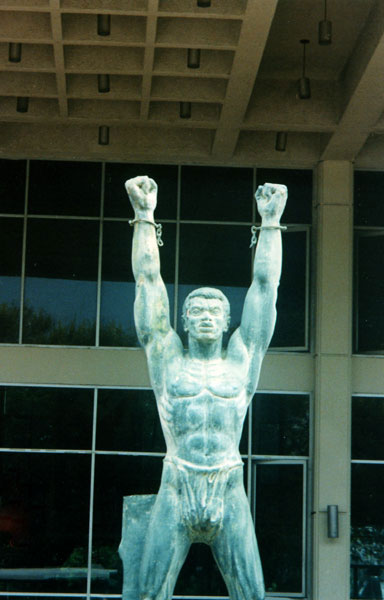
In DR, no black consciousness or "negritud" movements stressing racial uplift and pride developed as they did in Cuba, Puerto Rico, Trinidad or Jamaica such a movement might have contested these derogatory attitudes toward the country African heritage. One need to observe the absence of positive representations (photographs, street names, etc...) of Afro-Caribbeans in the public space with the exception of a statue of maroon leader Sebastian Lemba outside the anthropological museum.
Although the indegenous population was virtually exterminated shortly after Spanish invastion, the upper and middle class clung to the notion that the country's population and culture was Spanish and Indian; for instance, in the press and on cédulas (national identity cards), Afro-dominican are referred to as indios claros or indios oscuros (ligh or dark indians) while the term negro is reseverved only for Haitians. " Original link to GoogleBook here
Our readers may recall 2008 when Silvio Berlusconi hails(ed) 'handsome and suntanned' Barack Obama and in 2009 when he said ''It's painful to wander around cities like Rome, Naples and Palermo and see that with the graffiti and the filth on the streets they seem more like African cities than European ones, (because of the number of foreigners ) link.
by Deborah Pacini Hernandez
Temple University Press
ISBN 1-56639-299-3
Excerpt from pp.130-135
"(DR) has a long history of either actively rejecting or passively ignoring its unequivocally obvious African heritage. This attitude has often been linked to the historical consequences of a 22-year occupation by Haiti that made the Dominican Republic the only country in Latin America to be subjugated by blacks. The Haitian occupiers implemented a number of policies that directly benefited the Dominican population; for example, they abolished slavery and distributed land to peasants. Nevertheless, the Santo Domingo elite chafted at being ruled by people of color whose culture and language, moreover, were different from their own.
As a result, the country's Independance Day, february 27, does not commemorate independence from the centuries-long Spanish colonial rule, but rather the 22-year occupation by Haiti. In the aftermath of the Haitian occupation, Dominican conflated their hatred for Haitians with a generalized rejection of blackness and anything associated with African culture. Trujillo exacerbated these attitudes during his long regime by enacting policies -- such as the prohibition of folk traditions with clear African or Haitian antecedents and his ultimate racist policy: the 1937 order to massacre all Haitians residing in DR. (...) IN the post-Trujillo period, Dominican racism persisted unabated and indeed may have worsened as an influx of Haitian cane cutters was perceived as threatening to darken the country presumably superior (!) white blood.
Balaguer also shared these negative views of Haitians and their African-derived culture notably in his book "La isla al revés: Haiti y el destino dominicano" (1983).
In DR, no black consciousness or "negritud" movements stressing racial uplift and pride developed as they did in Cuba, Puerto Rico, Trinidad or Jamaica such a movement might have contested these derogatory attitudes toward the country African heritage. One need to observe the absence of positive representations (photographs, street names, etc...) of Afro-Caribbeans in the public space with the exception of a statue of maroon leader Sebastian Lemba outside the anthropological museum.
Although the indegenous population was virtually exterminated shortly after Spanish invastion, the upper and middle class clung to the notion that the country's population and culture was Spanish and Indian; for instance, in the press and on cédulas (national identity cards), Afro-dominican are referred to as indios claros or indios oscuros (ligh or dark indians) while the term negro is reseverved only for Haitians. " Original link to GoogleBook here
Our readers may recall 2008 when Silvio Berlusconi hails(ed) 'handsome and suntanned' Barack Obama and in 2009 when he said ''It's painful to wander around cities like Rome, Naples and Palermo and see that with the graffiti and the filth on the streets they seem more like African cities than European ones, (because of the number of foreigners ) link.
vendredi 3 juillet 2009
NYU Hemispheric institute of Performance and Politics on gagá dominicano
Gagá derives from the carnivalesque Haitian Rará, which is an Afro-Creole processional celebration that has a specific rhythm and dance. The migration of Haitian Rará to the Dominican Republic results from the movement of laborers from Haiti to Dominican cane fields...
more on : http://hemi.nyu.edu/eng/seminar/usa/studentwork/suriel/hemipaper.html
*This is an interview with Boni Raposo y La 21 División performed by the NYU Hemispheric institute of Performance and Politics
The music of Boni Raposo can be purchased at: http://www.cduniverse.com/search/xx/music/pid/7528706/a/Afro-Caribbean+Chants+And+Drums.htm
more on : http://hemi.nyu.edu/eng/seminar/usa/studentwork/suriel/hemipaper.html
*This is an interview with Boni Raposo y La 21 División performed by the NYU Hemispheric institute of Performance and Politics
The music of Boni Raposo can be purchased at: http://www.cduniverse.com/search/xx/music/pid/7528706/a/Afro-Caribbean+Chants+And+Drums.htm
Inscription à :
Articles (Atom)